


How It Works
How It Works
The 9 volt battery powered Critter Gitter is Fully automatic and uses a combination of heat and motion to detect intruders.
The Critter Gitter uses body heat and motion detection to detect animals as they enter a protected area. Critter Gitter then emits a high-pitched sound, which frigtens them away and then resets for the next intrusion. The Critter Gitter's high intensity flashing LED lights and series of flashing sound patterns keeps animals on guard and prevents them from becoming accustomed to just one sound. After a few attempts, wild and domestic animals alike will be trained to stay away from precious gardens, yards, plants and rubbish areas.
How it works:
Animals use their natural senses to warn them of danger. Most
important of these senses is hearing. Whenever an animal hears
danger sounds, they flee, learning to stay away from "dangerous"
areas. Using Passive Infrared, body heat and motion detection the
Critter Gitter detects animals moving into its protected areas. It
then makes piercing sounds and flashes lights to send them
fleeing. Once they have cleared the area the Critter Gitter
automatically changes its sound pattern.
How to use:
Do not be alarmed if the unit sounds during initial warm-up.
1. Mount or place the Critter Gitter so that the Critter Gitter does not move.
If the CG is mounted on something that moves, it will trigger in the wind.
Mounting it stationary will prevent wind from triggering it.
2. Mount or place the Critter Gitter so that the animal must enter the protected area. If laid on its back, it protects the area from above. Optionally, it can be placed where the animal must cross in front of the Critter Gitter but then the animal can't be sure it was for him.
3. Slide the switch located on the side of the unit to "Low" or "High" sound output. The center position is "Low". The top position is "High", and the bottom position is "Off".
4. Allow 30 seconds for the Critter Gitter to warm up. Note: It may sound as it warms up. If so, allow it to sound until the unit resets itself. Keep the area clear of movement.
5. The Critter Gitter will sound when an animal enters the protected area. The Critter Gitter will then reset and wait for the next intrusion.
Mounting original packaging:The Critter Gitter comes complete with provisions for mounting. Attach or mount the Critter Gitter to any secure surface, such as a wooden stake or fence, or tree.
Note: The Critter Gitter is NOT waterproof. It comes with a plastic hood to use if there is no other protection from moisture. When using the protective weather hood, be sure to place the hood completely over the unit so that all excess bag on the open end hangs below the unit. Do not close the bag or moisture may condense inside the bag. Allow the nail or screw head to push the "hood" into the mounting hole when mounting. The protective weather bag decreases the range by approximately 10%. The normal range is approximately 40 feet. At that distance, its protection width is also approximately 40 feet. Imagine a pie shaped wedge that is 40 feet away from the sensor and 40 feet wide. That is the area it will cover,
The Critter Gitter Weatherproof Mounts come complete with both top and bottom mounting holes and a hook and loop strap for mounting. Attach or mount the Critter Gitter to any secure surface, such as a wooden stake or fence, or tree.
The normal range is approximately 40 feet. At that distance, its protection width is also approximately 40 feet. Imagine a pie shaped wedge that is 40 feet away from the sensor and 40 feet wide. That is the area it will cover, (Approximately 800 square feet)
Troubleshooting:
If the Critter Gitter sounds intermittently or when no motion is
present, disconnect the battery for 30 seconds or more, then
re-connect. If this does not resolve the problem, the battery is
low an must be replaced.
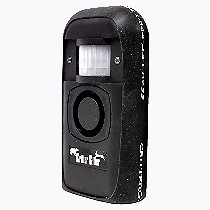
Weatherproof Critter Gitter Version 2 plus mounting extras
(Suggested Retail: $174.95)Sale Price $99.95
9 volt battery included.
Hook and Loop Strap included.
Wt. 5.4oz.
In Stock
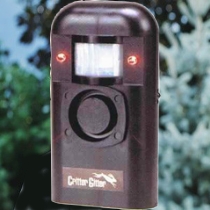
The Original Critter Gitter® plus mounting extras
(Suggested Retail: $169.95)Sale Price $89.95
9 volt battery and protective weather hood included.
Weight 5.3oz
IN STOCK
Send us your comments or questions
Your email address will not be published. Required fields are marked